Why is it that when the “disciples” are mentioned, we automatically picture in our minds the 12 men named in scripture that Jesus chose to be some of his closest followers? Why do we not also conjure up the more complete picture of the named women who followed Jesus, traveled with Jesus, sat and learned from Jesus, supported Jesus financially, and were present in greater numbers at the cross and the tomb than his so-called “closest” followers? I can tell you why . . .
because most sermons from most pulpits focus on the men and not the women, because most stained glass windows have pictures of male followers surrounding Jesus instead of women, and because most of the Sunday School Bible story pictures we grew up with were of the male disciples and not the women disciples. To see the women in scripture surrounding Jesus, you have to pay attention to the details of the story, you have to think about what you’re reading, and you have to look deeper into the historical, cultural, and social contexts of the biblical text. You have to be like Jesus and take time to see the women.
During this Holy Week, I encourage you to re-read the Gospel accounts of the crucifixion, burial, and resurrection. Watch for the women. Notice where they enter the story. Notice where they are during the different events in the story. And take time to notice when the men are absent or are in smaller numbers. Notice who stays with Jesus till the bitter end. Notice who returns first to the tomb of Jesus. Notice to whom Jesus chooses to appear first after the resurrection. Notice who is the first to deliver the resurrection message . . . and to whom . . . and at whose request (See John 20).
One of the first religious icons I searched for to add to the one of Christ I already had was of “The Holy Myrrhbearers.” Have you ever heard that term? It was new to me back in 2007. I had returned from my 2+ years in the beautiful Eastern European country of Romania where I had become acquainted with the ancient Eastern Orthodox Church. I regret now that I did not learn more about the Orthodox faith while I was immersed in a culture that practices it; however, my growing collection of icons and my reading about the history and purpose of icons has helped me to continue to feel connected to my Romanian friends. The icon of “The Holy Myrrhbearers” is a painting of 8 women who are named in the different gospels who may have been present at the cross and the tomb. At the top of the icon is Mary (the mother of Jesus), and then the four on the back row, left to right are Mary (wife of Cleopas), Martha (sister of Lazarus), Mary (sister of Lazarus), and Joanna (wife of Chuza), and on the front row, left to right are Salome, Mary Magdalene, and Susanna. (See Luke 8:1-3, Matthew 27:55-56, John 20, Mark 15, and Luke 24).
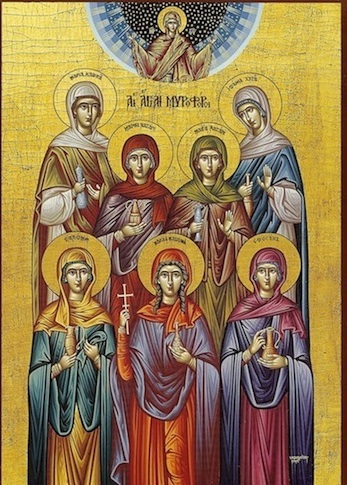 Scripture memorializes a group of named and unnamed women as the ones who followed Jesus from Galilee to Jerusalem. Mary Magdalene and Mary, Jesus’ mother, are two of the three people that the gospels specifically name who were actually at the cross. The third was John, Jesus’ best friend.
Shouldn’t the model for discipleship be the type of person who will be faithful to the end, in spite of the risk, in the face of hardship, in the midst of pain and trauma? Since it was the women who were the greater risk-takers as disciples of Jesus, I am choosing to base my understanding of the role model for following Jesus on their example and not so much on the the example of the men who chose to deny, flee, hide, and run when Jesus was facing his darkest hour.
I hope you will have a blessed and beautiful Easter as we celebrate the news that Christ is Risen Indeed–the truth that makes all things new and possible!
Question for the day: What can you do to remind others that we all–both women and men–need to hear the biblical stories of the women as models for discipleship?


Great post, Laura – and love the icon!
LikeLike